
Incident Response Service
When a cyber incident threatens business operations, the priority is to understand what has happened, contain the threat and move towards recovery without unnecessary delay. Abersecure provides an incident response service for managed customers that need experienced technical support when suspicious activity, account compromise, ransomware or another serious security event requires immediate investigation.
Because Abersecure already works within the managed environment, incident response does not begin with an unfamiliar provider trying to understand your systems during a crisis. Existing technical knowledge, management access and wider visibility across supported infrastructure can help create a faster route into investigation, containment and coordinated recovery.
Incident response is included within Abersecure Professional, Advanced and Enterprise managed packages without requiring a separate annual incident response retainer.
Rapid Containment When a Cyber Incident Becomes Active
When a cyber incident becomes active, the immediate priority is to establish what has been affected, limit further exposure and protect the systems the business depends on. Abersecure provides a structured incident response service focused on rapid technical assessment, controlled containment and coordinated recovery.
For managed customers, response begins with existing knowledge of the supported environment rather than a cold handover to an unfamiliar provider. Established access, documentation, monitoring context and service history can help accelerate investigation and support more informed containment decisions during the early stages of an incident.
This allows security response to remain connected to the wider operational environment. Where containment affects user access, Microsoft 365, endpoints, networking or infrastructure, Abersecure can coordinate the required technical action through the same service relationship that supports our IT support for businesses in Aberdeen.
The objective is to reduce uncertainty during the incident, establish technical control and move the organisation towards a safe and managed recovery path with clear ownership throughout the response.

Incident Response Built Into Your Managed Service
Effective incident response depends on having a defined technical process ready before a serious security event occurs. Abersecure includes structured incident response within its managed service, giving customers an established route for investigation, containment and recovery without needing to arrange a separate response provider during the incident.
Clear Incident Ownership
When a serious cyber incident occurs, Abersecure takes technical ownership of the response process from initial assessment through containment, recovery and escalation, giving the business one established route for coordinated action.
Response Across the Managed Environment
Containment and recovery can extend across supported Microsoft 365 services, endpoints, user accounts, networking and infrastructure where the incident requires wider technical action.
Evidence-Led Investigation
Incident decisions are supported by available alerts, logs, system information and affected asset context, helping engineers establish scope and take proportionate containment action based on evidence.
Reducing Operational Impact During a Cyber Incident
A cyber incident can quickly affect more than a single device or account. Access restrictions, compromised credentials, unavailable systems and containment actions can all disrupt normal operations, making the response process as much about protecting business continuity as removing the immediate threat.
Abersecure coordinates technical containment with the wider managed environment so that actions can be taken with an understanding of the systems and services the organisation depends on. This helps avoid unnecessary disruption while still allowing affected assets, accounts or services to be isolated where required.
Incident response also operates within Abersecure’s wider cyber security services in Aberdeen, allowing protective controls, monitoring, investigation and recovery activity to remain connected rather than being handled as separate technical functions.
For management, this provides clearer technical direction during a serious incident and a more controlled route from initial compromise through containment, recovery and return to normal business operations.
What Your Business Gains from a Structured Incident Response
A well-managed incident response process gives the business more than technical containment. It provides clearer ownership, faster decision-making and a controlled route through investigation, recovery and post-incident improvement when a serious cyber event affects normal operations.
Faster Containment Decisions
Established technical context helps engineers identify affected systems and take proportionate containment action sooner, reducing the time an active threat can continue affecting the environment.
Clear Technical Ownership
The response follows one coordinated technical process from initial assessment through containment and recovery, giving the business a defined route for action rather than fragmented responsibility.
Reduced Operational Disruption
Containment decisions are made with consideration for the wider managed environment, helping protect critical systems while avoiding unnecessary interruption to unaffected business operations.
Coordinated Recovery
Affected accounts, endpoints, cloud services and infrastructure can be restored through a controlled recovery process designed to reduce the risk of returning compromised systems to normal operation too early.
Better Management Visibility
Management receives clearer information about the incident, affected areas, response actions and recovery progress, supporting informed business decisions throughout the event.
Post-Incident Improvement
Once the immediate incident is controlled, findings from the investigation can be used to identify weaknesses, improve existing controls and reduce the likelihood or impact of a similar event occurring again.
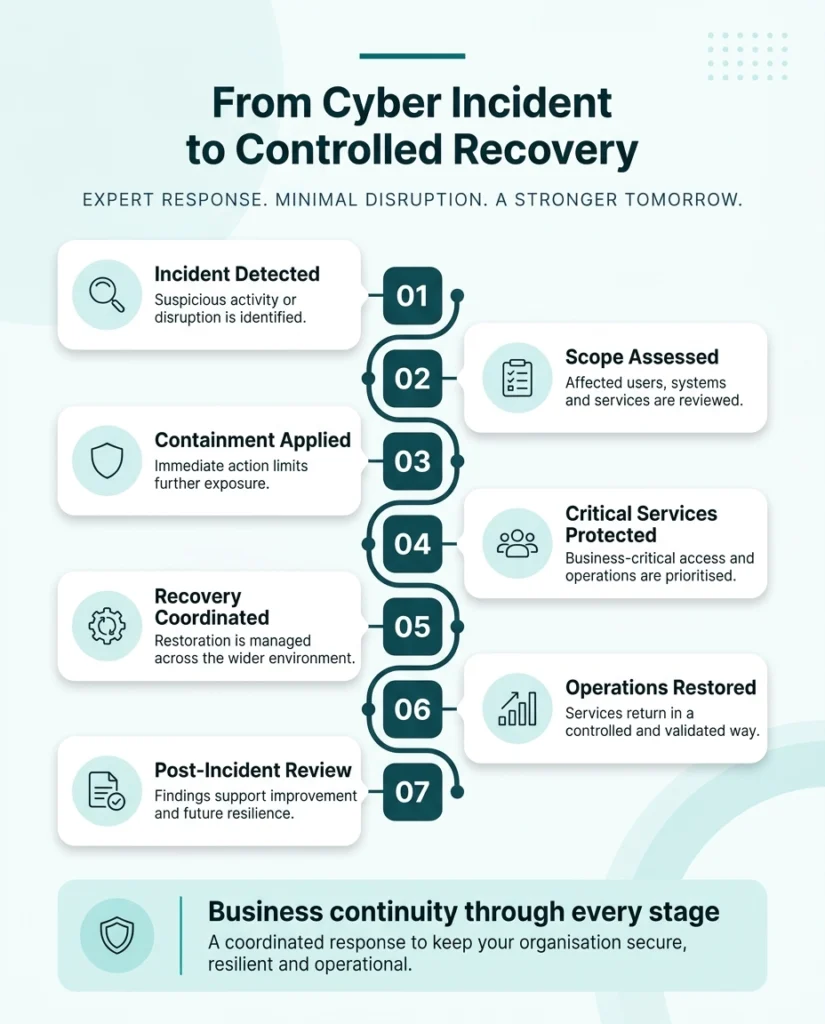
How Abersecure Manages an Active Cyber Incident
Once an incident is confirmed or requires formal investigation, Abersecure moves through a structured response process designed to establish scope, contain the threat and support a controlled recovery. Technical actions are prioritised according to the systems affected, the level of compromise and the potential impact on business operations.
Investigation can include reviewing available alerts, account activity, endpoint information, Microsoft 365 events, infrastructure logs and other relevant evidence from the managed environment. Where necessary, affected users, devices, accounts or services can be isolated while the wider environment is assessed for related activity.
Containment is followed by remediation and recovery, with compromised access removed, affected systems reviewed and services returned to operation in a controlled way. This incident handling process sits within Abersecure’s broader cyber security services, allowing response activity to remain connected to the controls and systems already protecting the organisation.
Throughout the incident, the objective is to maintain clear technical ownership and give the business a defined route from initial investigation through containment, recovery and post-incident review.


When Detection Escalates Into Incident Response
Not every security alert becomes a major incident. Some events can be investigated and resolved through normal monitoring and security operations, while others require a broader response when there is evidence of compromise, active attacker behaviour or material risk to business systems.
Where Managed Detection and Response identifies activity that requires coordinated containment or recovery, the incident can move into the incident response process without forcing the customer to engage a separate provider or rebuild the technical context from the beginning.
This allows investigation findings to carry directly into response activity. Indicators, affected assets, suspicious accounts and other relevant evidence can be used to guide containment decisions and determine which systems or services require further action.
The distinction is clear: MDR provides ongoing detection, investigation and escalation, while incident response takes responsibility when a security event requires coordinated containment, recovery and wider technical management.
Incident Response Ready Before an Incident Happens
Incident response is most effective when access, responsibilities and escalation routes are established before a serious event occurs. Abersecure builds that response capability into the managed service so customers already have a defined technical route for urgent investigation and containment when it is needed.
24/7 Emergency Incident Activation
Serious cyber incidents can be escalated for emergency response at any time, giving managed customers an established route to technical assistance when compromise or active disruption cannot wait for normal business hours.
No Separate Incident Response Retainer
Incident response is included within Professional, Advanced and Enterprise managed packages, removing the need to purchase a separate annual response retainer simply to have access to the service when an incident occurs.
Response Already Connected to Your Environment
Because Abersecure already supports the managed environment, incident response can begin with established technical context, access and service knowledge rather than starting with a new provider during an active security event.
Incident Response Included Across Managed Packages
Abersecure includes incident response capability within the Professional, Advanced and Enterprise managed packages, giving customers an established route to investigation, containment and recovery without needing to arrange a separate incident response retainer.
The right package depends on the wider level of IT management, security oversight and operational assurance your organisation requires, but incident response remains part of the managed service across all three options.
Incident Response Service FAQs
These frequently asked questions explain how Abersecure’s incident response service works for managed customers, including package inclusion, emergency activation, escalation, recovery and the relationship between incident response and Managed Detection and Response.
Is incident response included in all Abersecure managed packages?
Yes. Incident response is included within the Professional, Advanced and Enterprise managed packages.
This means managed customers already have an established route to technical investigation, containment and recovery without needing to purchase a separate annual incident response retainer.
Do we need a separate incident response retainer?
No separate incident response retainer is required for customers covered by the Professional, Advanced or Enterprise managed packages.
Incident response forms part of the wider managed service, so the response relationship, escalation path and technical context are already established before an incident occurs.
Can we activate incident response outside normal business hours?
Serious cyber incidents can be escalated through Abersecure’s emergency response route on a 24/7 basis where immediate technical action is required.
This is intended for active or suspected compromise, ransomware, account takeover, business email compromise or another significant security event that cannot reasonably wait until standard business hours.
What happens when we report a suspected cyber incident?
The first priority is to establish the nature and likely scope of the incident, identify affected systems or accounts and determine whether immediate containment is required.
Available alerts, logs, endpoint information, Microsoft 365 activity and wider managed environment context can then be used to support investigation, containment decisions and the recovery process.
What is the difference between Incident Response and Managed Detection and Response?
Managed Detection and Response focuses on ongoing monitoring, investigation and escalation of suspicious security activity.
Incident response takes over when an event requires coordinated containment, recovery and wider technical management across the affected environment.
Can Abersecure coordinate recovery across different systems?
Yes. Where the incident affects supported Microsoft 365 services, endpoints, user accounts, networking, servers or other managed infrastructure, recovery actions can be coordinated across the wider environment.
This helps avoid fragmented recovery work across separate providers and keeps technical ownership within one response process.
What happens after the incident has been contained?
Once the immediate threat has been controlled, the affected environment can move through remediation, recovery and validation before normal operation is fully restored.
Incident findings can also be reviewed afterwards to identify weaknesses, improve existing controls and reduce the likelihood or impact of a similar event occurring again.