Knowing when to use on-demand IT support can help a business control IT costs without paying for more support than it currently needs. For organisations with relatively stable technology and only occasional problems, getting professional IT support in Aberdeen as required can be a practical alternative to an ongoing managed support agreement.
On-demand IT support can also be useful during short-term projects, staff absence or periods when additional technical expertise is needed. For businesses that only require occasional assistance, pay as you go IT support in Aberdeen provides a flexible route to technical support without committing to a full managed service.
This guide explains when on-demand IT support makes sense, what it can cover, what businesses should check before requesting support and the signs that it may be time to move towards a more proactive support model.
What Is On-Demand IT Support?
On-demand IT support is a flexible way of accessing technical assistance when a problem or specific requirement arises. Instead of paying a recurring monthly fee, a business requests support when it needs it and is charged according to the service being provided.
This type of support is often associated with pay-as-you-go IT services. Many problems can be investigated remotely, while onsite assistance may be required for physical equipment, network issues or work that cannot reasonably be completed through a remote connection.
Typical requests may involve Microsoft 365, email problems, user accounts, software configuration, desktops and laptops, connectivity issues, device setup or troubleshooting business applications.
The important distinction is that on-demand IT support is normally reactive. The provider responds when assistance is requested rather than continuously managing and monitoring the wider IT environment.
When Is On-Demand IT Support the Right Fit?
Understanding when to use on-demand IT support starts with looking at how frequently your business actually needs technical assistance.
If your systems are generally reliable and support requests are uncommon, paying for assistance only when required may make financial sense. This is particularly relevant to smaller businesses that have straightforward IT environments or already have somebody internally who can handle basic day-to-day tasks.
On-demand IT support can also work well when a business needs additional expertise for a limited period rather than permanent external IT management.
Examples include:
- Occasional technical problems that happen only a few times each year.
- A short-term office move or technology project.
- Temporary cover while an internal IT employee is unavailable.
- Additional technical capacity during a busy period.
- A difficult problem that requires expertise not available internally.
- Support while a business assesses whether it needs a longer-term IT arrangement.
The common factor in these situations is that the requirement is occasional. If the same problems repeatedly return or support becomes necessary every week, on-demand IT support may no longer be the most effective approach.
Common Situations Where On-Demand Support Works Well
One of the clearest examples of when to use on-demand IT support is when there is a defined problem with a clear beginning and end.
A business moving premises, for example, may need additional support to reconnect devices, configure equipment or troubleshoot connectivity during the move. Once the project has been completed, the additional support may no longer be required.
Another example is temporary staff cover. If the person normally responsible for IT is on leave or unavailable, on-demand IT support can provide additional technical capacity without immediately changing the organisation’s long-term support model.
It can also be appropriate when an internal team encounters a technical issue outside its normal experience. Rather than maintaining specialist expertise internally for something that happens rarely, the business can request help when the requirement appears.
What Should You Check Before Using an On-Demand Provider?
Deciding when to use on-demand IT support is only part of the decision. Businesses should also consider how the provider will access and work with their systems.
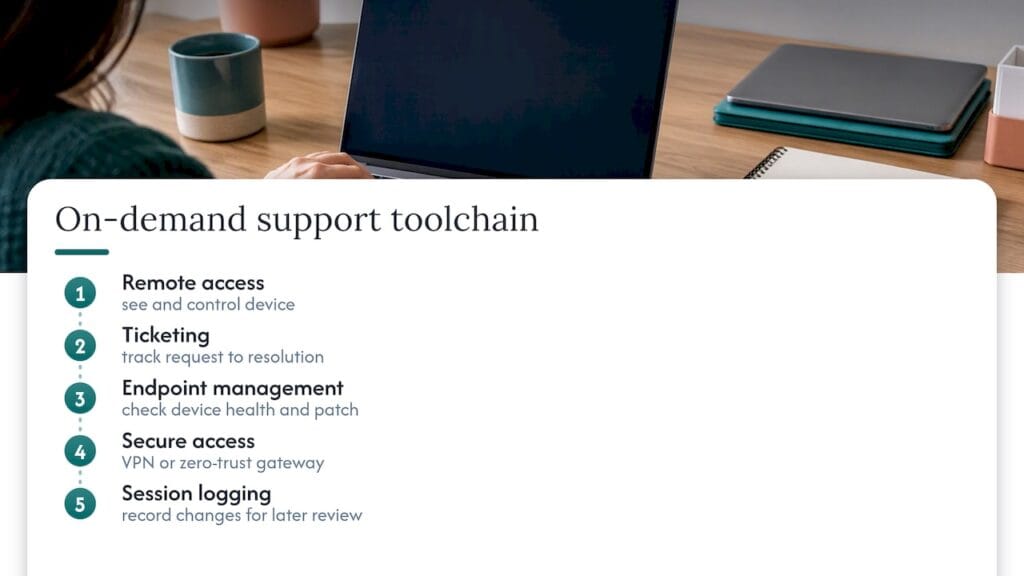
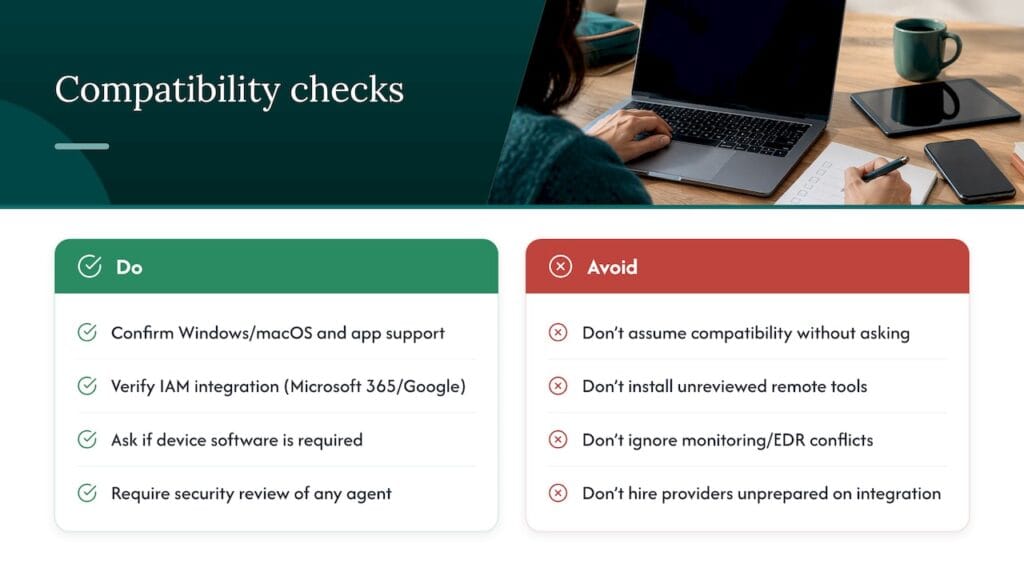
An IT support provider may need access to devices, Microsoft 365, administrative accounts, network equipment or other important systems. Businesses should therefore understand how remote access is secured, how privileged accounts are handled and whether significant changes are documented.
Useful areas to check include:
- How remote access to business devices is secured.
- Whether multi-factor authentication is used where appropriate.
- How administrator and privileged access is controlled.
- What information the provider records about work completed.
- How urgent issues are escalated.
- Whether onsite support is available where required.
- How the provider works alongside existing security and monitoring tools.
The National Cyber Security Centre guidance on choosing a managed service provider is a useful reference when considering third-party access, responsibilities, security arrangements and service expectations.
Businesses should avoid assuming that security automatically comes with technical support. The way an issue is resolved can be just as important as resolving the issue itself.
When Is On-Demand IT Support No Longer Enough?
There is also a point where knowing when to use on-demand IT support means recognising when not to use it.
If employees regularly lose time because of technical problems, the same types of faults keep returning or important systems need continuous attention, repeatedly requesting individual support sessions may become inefficient.
Other signs that a business may need a more proactive model include:
- Support requests becoming frequent rather than occasional.
- Recurring faults affecting the same users or systems.
- Downtime beginning to affect productivity or customers.
- A growing number of users, devices or locations.
- Increasing cybersecurity or compliance requirements.
- A requirement for continuous network or infrastructure monitoring.
- A need for predictable support availability and ongoing maintenance.
These situations often require more than fixing individual faults. They require somebody to understand the wider environment, identify patterns and reduce the likelihood of problems occurring in the first place.
When to Move to Managed IT Support
On-demand IT support and managed IT support are designed for different levels of need. On-demand support works well when assistance is occasional, while managed support is more suitable when IT requires ongoing attention.
If support requests become regular, systems need continuous monitoring or downtime is starting to affect the business, managed IT support in Aberdeen may be a more suitable long-term approach.
A managed service can provide ongoing monitoring, maintenance, structured support and greater visibility across the wider IT environment. This becomes increasingly valuable as a business grows, adds more devices, relies on cloud services or becomes more dependent on technology for day-to-day operations.
On-demand IT support can therefore be a useful starting point, but businesses should review their support model as their requirements change.
Choosing the Right Support Model for Your Business
There is no reason for every business to move immediately to a managed agreement. For organisations with stable systems and genuinely occasional requirements, on-demand IT support can provide flexibility while keeping costs proportionate to the amount of assistance required.
The important point is to review the situation regularly. An approach that works for a small team with a straightforward environment may become less suitable as the company grows, adds more users, introduces additional locations or becomes increasingly dependent on technology.
Choosing the right support model comes down to frequency, complexity, business impact and how much ongoing responsibility you want your IT provider to take.
Frequently Asked Questions
What is on-demand IT support?
On-demand IT support is technical assistance provided when a business requests it, usually without a recurring managed support agreement. It is often suitable for businesses with occasional or unpredictable IT support requirements.
When should a business use on-demand IT support?
A business should consider on-demand IT support when technical problems are occasional, its IT environment is relatively stable and it does not require continuous monitoring or management. It can also work well for short projects, temporary staff cover and specialist troubleshooting.
Is on-demand IT support the same as pay-as-you-go IT support?
The terms are often used to describe a similar approach. Both generally involve requesting technical support when it is needed rather than paying for an ongoing managed support agreement.
Is on-demand IT support suitable for a small business?
Yes. Small businesses with straightforward and stable IT environments may find on-demand IT support particularly useful when support requirements are infrequent. As the business grows or becomes more dependent on technology, a managed service may become more appropriate.
Can on-demand IT support be provided remotely?
Yes. Many software, Microsoft 365, user account and configuration problems can be investigated remotely. Some network, hardware and infrastructure problems may require onsite assistance.
When should a business move from on-demand support to managed IT support?
A move towards managed support should be considered when problems become frequent, downtime affects normal operations, the environment becomes more complex or the business requires proactive monitoring, maintenance and ongoing technical oversight.