IT project governance is the set of roles, decision rights and checks that decide who directs a technology project, who approves changes and how progress is reported. Good project management delivers tasks. Governance makes sure the right people can steer, challenge and stop the work. This guide explains the structures, the oversight routines and a proportionate way to put them in place, with UK public-sector guidance as the benchmark.
What IT project governance covers
The Government’s Teal Book describes a governance and management framework as the authority limits, decision-making roles and rules, degrees of autonomy, assurance needs, reporting structure, accountabilities and roles a project needs. That is a useful checklist for any organisation, whatever its size.
In practice, IT project governance answers five questions before work starts:
- Who owns the business case and is accountable for the outcome?
- What can the project manager decide alone, and what must go upwards?
- How often, and in what format, is progress reported?
- Who checks that the work is sound, independently of the team doing it?
- When does the project get paused, reset or stopped?
If your answers are vague, the project is being run on goodwill. That works until a supplier slips, a budget is questioned or a security issue appears mid-build.
How it differs from project management and IT governance
The three terms are often blurred, but they do different jobs.
- Project management plans and delivers the work: schedule, tasks, resources, budget tracking.
- IT project governance sets the rules and decision rights under which that work happens.
- IT governance is the wider structure that ensures IT investments are appropriately deployed and achieve desired results across the organisation.
The same academic study notes that a company can have good project management without good project governance. A well-run project can still be the wrong project, or can carry risks nobody with authority has seen. Project governance sits inside IT governance, so your project rules should reflect your wider technology policies on security, suppliers and data.
Roles and decision rights
Governance fails most often at the point where nobody is sure who decides. The Teal Book names the senior responsible owner (SRO) as the owner of the business case and the framework, responsible for defining the vision, assuring ongoing viability, setting risk tolerance and engaging stakeholders. In government, a board supports the SRO, with its purpose set out in terms of reference.
The APM’s Directing Change guide frames it slightly differently. It identifies two roles accountable for effective governance, the board and the sponsor, supported by the project or programme manager, business change manager, independent reviewer and PMO.
For a small or medium-sized business, you will not fill every seat with a different person. You can still keep the functions distinct:
| Function | Typical holder in an SME | What they decide |
|---|---|---|
| Sponsor or SRO | Managing director or finance director | Business case, budget, go or stop |
| Project manager | Internal lead or outsourced IT manager | Day-to-day delivery within agreed limits |
| Independent reviewer | A person outside the delivery team | Whether the project is on track and sound |
| Supplier lead | Vendor account manager | Delivery of contracted work |
The key is to write down the limits. The UK Guidelines for Managing Projects state that changes beyond the project manager’s authority must be referred to the SRO or project board under an agreed change control process, with a more formal approach advised for medium to large projects.
Oversight across the project lifecycle
Oversight is governance in motion. The APM identifies four core functions that run through the life cycle: clarity of direction and authority, holding people to account, following due process, and reporting. Three routines carry most of the weight.
Assurance in layers
The Teal Book expects an integrated assurance plan with at least three levels: the framework itself, the working practices, and independent review. GovS 005: Digital describes the same idea as assurance by the operational team, by senior management independent of operations, and by independent bodies.
For an SME, that might mean the project lead checks their own controls, a director reviews at milestones, and an outside specialist reviews anything touching security or critical systems.
Risk escalation
The same UK guidelines say the SRO and any project board should be actively engaged in risk management so that emerging risks are escalated upwards as required. GovS 005 adds that digital risks, including security, legacy technology and technical debt, should be represented at board level and reviewed regularly. A structured IT risk assessment gives the board something concrete to review.
Change control
Uncontrolled change is where scope and cost drift. Our guide to IT change management controls covers the practical steps. Where projects depend on external suppliers, vendor risk management belongs in the same governance picture.
What weak governance costs
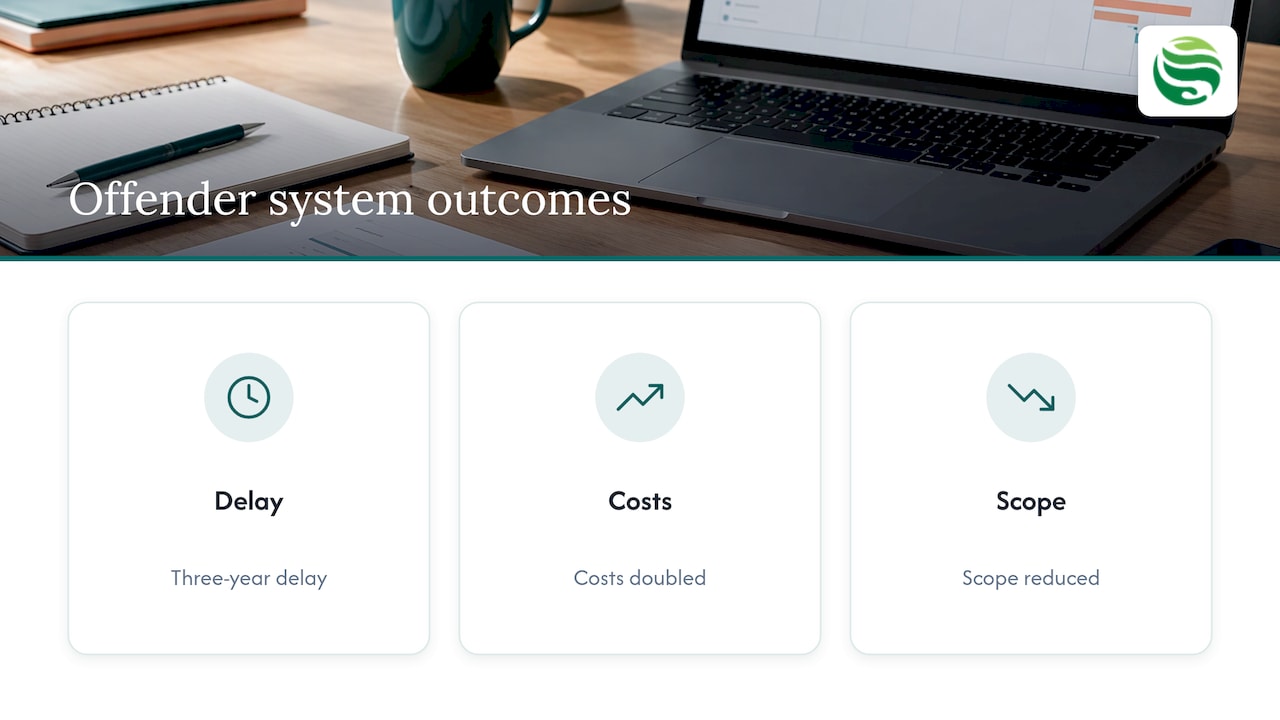
The National Audit Office’s review of the National Offender Management Information System found a three-year delay, a doubling in costs and reduced scope, with inadequate oversight, absent budget monitoring and weak change control. The NAO’s head said the problems could have been avoided with realistic budget, timescales and governance set at the start.
The lesson scales down. A website rebuild, a Microsoft 365 migration or a new line-of-business system rarely fails because of one dramatic event. It fails because nobody was watching the budget, nobody owned the change log and nobody had the authority to call a halt.
Building a proportionate framework
More governance is not better governance. The NAO notes that multiple layers of governance do not necessarily improve quality, speed up delivery or reduce risk, and that governance of agile delivery should be light touch and proactive. The Digital Assurance Playbook says assurance should be applied proportionately to the risk and value of the activity.
A practical sequence for an SME:
- Tier your projects. Separate routine changes from projects that carry real cost, security exposure or operational risk.
- Name the owner. One accountable sponsor per project, recorded in a one-page charter.
- Set authority limits. Spend, scope and timeline thresholds above which the project manager must escalate.
- Fix the reporting rhythm. A short, regular status note covering progress, budget, risks and open decisions.
- Add independent review at milestones. Scale it to the project’s risk.
- Define stop and reset triggers. The IPA describes a reset as needed when there is no credible route to successful delivery, a useful test for any project.
The Teal Book also advises that the framework should often be tailored from the sponsoring organisation’s existing delivery approach, which reduces documentation requirements. Start from what you already do rather than from a blank template.
Approval records matter too. If you need decisions to be traceable, a clear document approval workflow with auditable controls shows how sign-offs can be evidenced.
Where we can help
Many smaller organisations have no internal IT leader to own governance. Our Outsourced IT Manager service is built for that gap, and includes project oversight and vendor coordination alongside day-to-day technical management. Security by Default is our standard practice, so security is considered from the start of a project rather than added at the end. If you are planning a project in Aberdeen or Aberdeenshire, you can speak to Abersecure about how that oversight would work for your business. Our outsourced IT management checklist sets out what to expect in the first 30, 60 and 90 days.
FAQ
What is the difference between IT project governance and IT governance?
IT governance covers how an organisation directs and controls all its technology and investment. IT project governance applies those rules to individual projects, setting who decides, who is accountable and how progress is checked. Project governance is best seen as a subset of the wider IT governance framework.
Who is responsible for IT project governance?
Ultimately the board and the project sponsor, or the SRO in government terms. The project manager, an independent reviewer and any PMO support them with delegated responsibilities. In a small business, the managing director often acts as sponsor, with an internal or outsourced IT lead managing delivery.
How much governance does a small IT project need?
Enough to match its risk and value. For a low-risk change, a named owner, a budget limit and a short status note may be sufficient. For projects touching security, finance or critical systems, add milestone reviews and independent checks.
How does oversight differ from governance?
Governance sets the rules and decision rights. Oversight is the ongoing activity of monitoring progress, risks, changes and assurance against those rules while the project runs.