
A business continuity plan (BCP) is a short, practical document that tells your team what to do, in what order and who decides, when something stops your business operating normally. The Federation of Small Businesses defines it as a document that helps a company survive and keep running after a major disruption such as a fire, flood or cyber-attack. For most UK small and medium-sized businesses, a good plan is a few well-kept pages, not a manual. This guide covers what to put in it, how to build it in six steps and how to keep it current.
Is a business continuity plan a legal requirement in the UK?
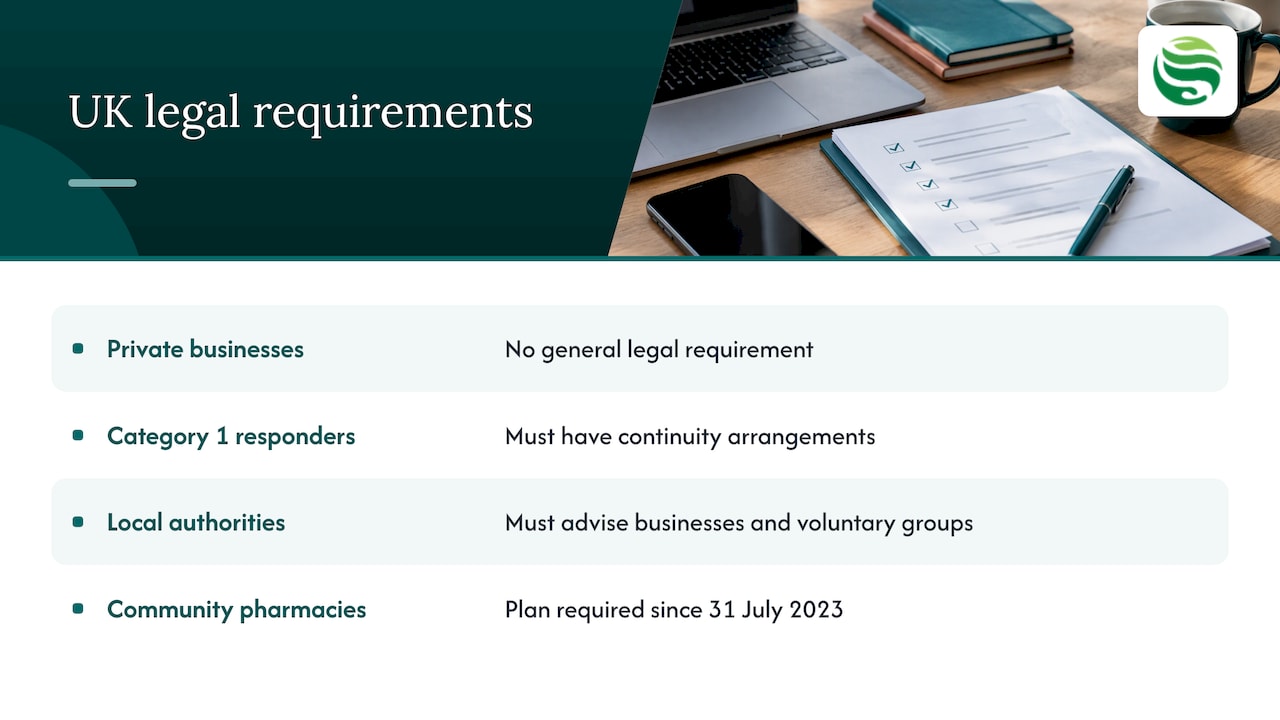
For most private businesses, no general law requires one. Under GOV.UK guidance on emergency planning, Category 1 responders, such as emergency services and local authorities, must have business continuity management arrangements. Local authorities must also give businesses and voluntary organisations advice on the subject. Some sectors have their own rules: since 31 July 2023, NHS community pharmacy owners must have a plan for a temporary suspension of service.
Check your sector rules, your contracts and your insurance terms. Customers and insurers increasingly ask whether a plan exists. The FSB notes that insurance may not cover every part of the risk, particularly delays or operational problems that fall outside a policy’s terms.
Business continuity versus disaster recovery
The two are related but not the same. According to the FSB, business continuity planning is broader and operational, while disaster recovery focuses on restoring IT and systems. Your IT recovery procedures sit inside the wider plan as one chapter. If your email, files and line-of-business software are down, the rest of the plan still has to tell people how to serve customers meanwhile.
Plan for outcomes, not for every cause
The list of things that could go wrong is endless. West Sussex County Council advises planning around the outcomes of a disruption rather than its causes. A business continuity incident generally means losing one or more of the following:
- staff or skills
- critical systems
- utilities
- access to or use of premises
- key resources or suppliers
A fire, a flood and a burst pipe all lead to the same question: where does your team work tomorrow? A ransomware attack and a failed server both mean the same thing: your systems are unavailable. Writing one response per outcome keeps the plan short enough to use under pressure.
How to write your business continuity plan in six steps
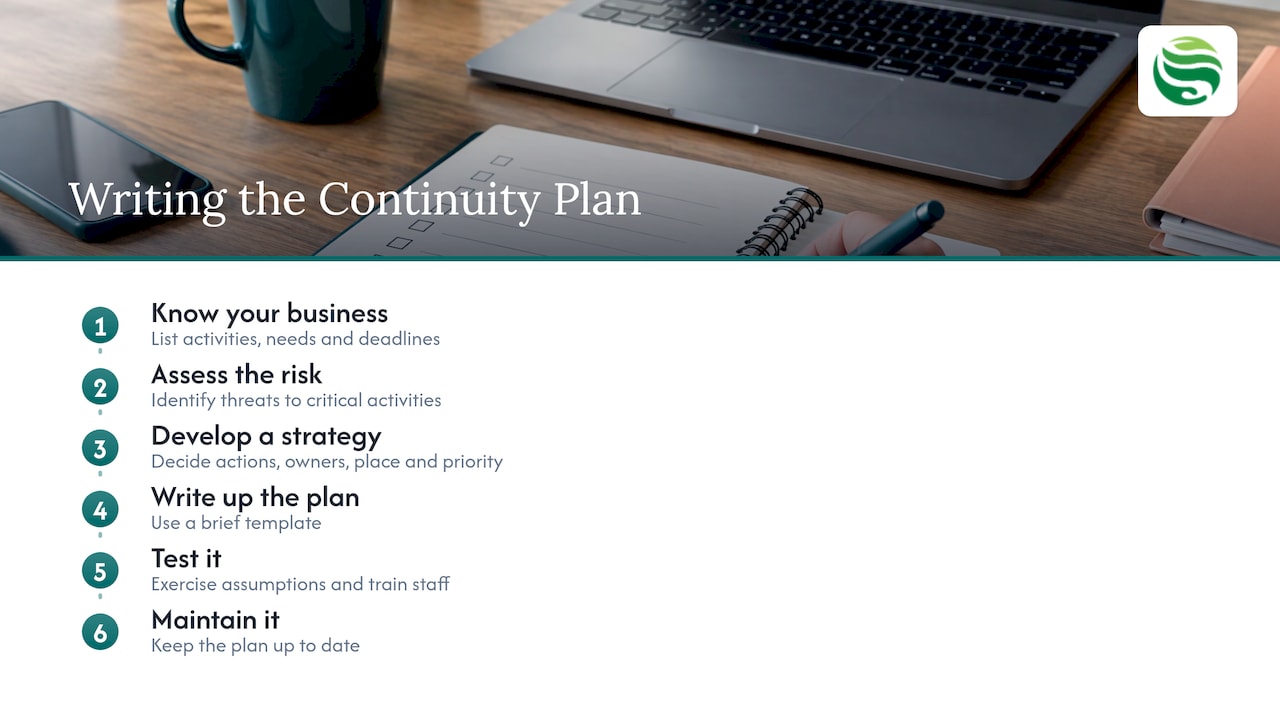
The Milton Keynes City Council guide sets out six steps that suit a small business well.
1. Know your business. List your key activities, what each needs to run (people, systems, premises, suppliers) and any deadlines attached, such as payroll or contract deliveries.
2. Assess the risk. Ask what could stop each critical activity. AXA’s guidance suggests covering employees, premises, customers, suppliers, finances, cashflow, IT, equipment, legal compliance and logistics, and involving staff, who may spot risks you have missed. For the technology side, our IT risk assessment guide walks through the steps.
3. Develop a strategy. Decide what will be done, how, by whom, where and in what priority. Durham County Council’s small business template asks which parts of the business you need within the first 24 hours, within 2 to 7 days and within 8 to 14 days. It also asks which suppliers depend on you and which you depend on.
4. Write up the plan. Use a template and keep it brief (see the next section).
5. Test it. Staff need to become familiar with the plan, and an exercise shows whether your assumptions hold.
6. Maintain it. The Milton Keynes guide warns that an out-of-date plan can be almost useless.
What a business continuity plan template should include
Councils and trade bodies publish free templates, so you rarely need to start from a blank page. West Sussex County Council says a plan should generally contain:
- purpose and scope
- document ownership, version control and distribution list
- roles and responsibilities
- how, when and by whom the plan is activated
- internal and external contact details
- critical functions, recovery timescales and recovery levels
- resources available in the first 24 hours and up to two weeks
- actions, timescales and responsible people
- communication processes
- a process for standing down and returning to normal
The Fire Protection Association template is aimed at small and medium-sized businesses and uses checklists for loss of premises, supply chain, equipment, IT and data, and staff. Durham’s template takes a form-based approach, including a summary of essential IT systems and records and a one-page plan summary.
Keep it short and give every task an owner
The UK government’s good practice indicators, written for emergency responders but sensible for any organisation, say plans should be short, simple and usable in difficult conditions. They should also have realistic assumptions and named owners for key tasks. The Manchester guidance adds that you should know who leads the response and who has authority to make important decisions.
Decide who talks to whom
A communications strategy is part of every plan we have cited. Record how you will reach staff, customers, suppliers and your IT provider if email is down, and keep a printed or offline copy of those numbers. If premises security or alarm monitoring forms part of your response, fire and security installers can be listed among your key contacts.
Where IT fits in your continuity plan
Most small businesses now rely on technology for almost every critical activity, so the IT section deserves proper attention. At a minimum, record:
- your essential systems and data, and how long you can cope without each
- where backups are held and who can restore them (our 3-2-1 backup guide explains a sound approach)
- how you would work if Microsoft 365 or a key cloud service were unavailable, see our note on Microsoft 365 backup gaps
- who to call during a cyber incident, with the steps in our ransomware response plan
- how staff would work remotely, covered in our remote work IT setup guide
- which suppliers are single points of failure, see vendor risk management
For the technical recovery detail, such as restore order and data breach reporting deadlines, see our guide to disaster recovery planning.
Also list your financial essentials. If invoicing and payments stop, cashflow suffers quickly, so note how you would keep billing and chasing payments, for example with invoice automation for small businesses.
How to test and review your plan
A plan is not valid until it has been tested, according to West Sussex County Council. It suggests a table-top walk-through using a fictitious scenario, or a live exercise where people play defined roles. The key output is the lessons learnt, which feed improvements and training needs.
Surrey County Council recommends reviewing the plan after major changes to premises, processes or services, or when a new threat emerges, and testing essential contact details at least every six months. South Cambridgeshire’s handbook says to update the plan whenever something changes, such as supplier contact details or staff, and to tell your insurer.
As a working rhythm for a small firm: run a table-top exercise once a year, check contacts every six months and review after any staff, supplier or system change. Testing physical safety kit, such as alarms, emergency lighting and extinguishers, can be handled by fire and electrical safety testing specialists so that it is recorded alongside the plan.
How Abersecure can help with the IT side
We support businesses in Aberdeen and Aberdeenshire with the technology part of continuity: Backup and Disaster Recovery, Incident Response and managed IT support with Security by Default. If you want your recovery procedures written and kept current by people who know your systems, get in touch.
Frequently asked questions
Do small businesses really need a business continuity plan?
There is usually no general legal duty, but a plan protects your ability to trade. South Cambridgeshire’s handbook describes creating one as quick, easy and inexpensive, and says it can be as simple as you want. A simple plan is also more flexible.
Where can I find a business continuity plan template for the UK?
Many local councils publish free templates, as do the Fire Protection Association and insurers. Pick one written for small businesses, then adapt it to your own critical activities, contacts and systems rather than filling it in generically.
How often should I review my plan?
Review it after any significant change and test contact details at least every six months, as Surrey County Council advises. Many organisations also run a full exercise annually. NHS England’s data security standard, for example, requires a yearly test of continuity plans for data security threats.
What is the difference between a BCP and a disaster recovery plan?
A BCP covers how the whole business keeps operating, including people, premises and suppliers. A disaster recovery plan covers restoring IT and data. The second is part of the first.